

How to Tell Gold From Pyrite and Mica
Every new prospector sees it sooner or later. A bright yellow flash in the pan, or a shiny cube in a piece of rock, and the heart starts pounding. Learning how to tell gold from pyrite and mica is one of the first skills I tell beginners to pick up, because a lot of what glitters in a pan is not gold.
The good news is that real gold behaves very differently from the look-alikes. You do not need a lab. You need your eyes, your pan, a pin, and a few minutes.
Is that yellow speck in your pan gold, or is it fooling you?
What Is Fool’s Gold?
According to the U.S. Geological Survey, fool’s gold can be one of three minerals:
- Pyrite, an iron sulfide (FeS2) (University of Minnesota). The USGS calls it the mineral most commonly mistaken for gold.
- Chalcopyrite, a copper iron sulfide that can also look gold-like.
- Weathered mica, such as biotite, which shows up as flat, shiny flakes in stream sediment.
Pyrite fools people with its metallic luster and yellowish hue. Biotite is different. It is not particularly yellow, but the USGS notes that small flakes in stream sediments can make a brilliant flash when light shines on them, and that flash has fooled people panning for gold in streams (USGS).
Real Gold vs. Fool’s Gold at a Glance
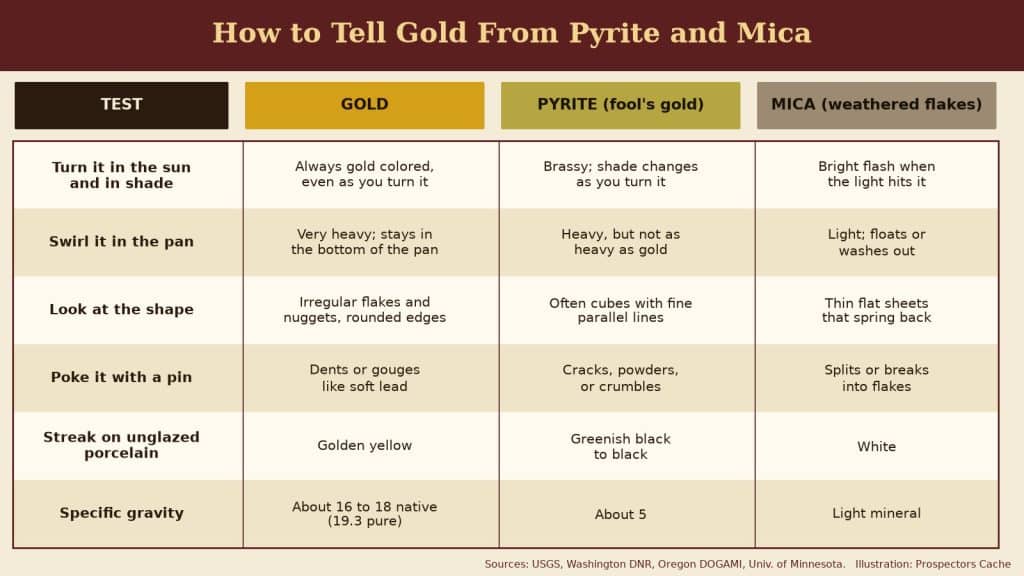
Here is the short version. Gold is soft, heavy, and always gold colored. Pyrite is hard, brittle, and brassy. Mica is light and flaky.
The USGS puts pure gold at a specific gravity of 19.3, and gold as it commonly occurs in deposits at about 16 to 18 (USGS: Gold). The University of Minnesota lists pyrite at about 5. That difference in weight is the reason gold stays in your pan when the look-alikes move.
How to Tell Gold From Pyrite: 5 Field Tests
The easiest way to learn how to tell gold from pyrite is to start with the tests that do not hurt the sample, then work toward the ones that do.
Test 1: Turn It in the Light
Rotate the pan or the rock in the sun, then shade it with your hand. The Oregon Department of Geology and Mineral Industries says pyrite has a brassy color, is sometimes tarnished, and changes shades as you rotate it in the sun. Gold is always gold colored (Oregon DOGAMI).
Mica flashes when the light catches it at the right angle. Gold does not need the right angle to look like gold.
Test 2: Watch It in the Pan
Weight does not lie. The Washington Department of Natural Resources says gold becomes concentrated in the very lowest part of the pan, while mica is light and washes out (Washington DNR). DOGAMI adds that gold-colored flecks that float on the water or wash out easily are probably mica.
Pyrite is trickier. Washington DNR describes it as heavy, but not as heavy as gold, so it can ride along with your black sand. That is why the pan alone is not enough to tell gold from pyrite.
Gold lags behind everything else in the pan. Watch what stays, not what flashes.
Test 3: Look at the Shape
Pick the piece up with tweezers and look at it under magnification. Pyrite often forms cubes or octahedrons, and the faces can show faint parallel lines called striations (University of Minnesota). Gold is almost always found in irregular shapes (Washington DNR), and most gold particles found in streams have slightly rounded edges (Geology.com).
Mica looks like what it is: thin, flat sheets. Washington DNR points out that mica flakes are elastic, so when you bend one it tends to spring back. Gold is malleable. It bends and stays bent.
Test 4: Poke It With a Pin
For small pieces, this test settles most arguments. Set the piece on a hard surface and press a pin into it.
The USGS says pyrite, chalcopyrite, and mica will flake, powder, or crumble when poked with a metal point, while gold will gouge or indent like soft lead (USGS).
Hardness explains why. Pyrite runs 6 to 6.5 on the Mohs scale and can scratch glass (University of Minnesota). Gold is about 2.5 (Geology.com), and the USGS says pure gold has about the hardness of a penny (USGS: Gold).
Test 5: Do a Streak Test
Scrape the piece across a piece of unglazed porcelain, such as a streak plate, and look at the color of the powder it leaves.
According to the USGS, gold leaves a golden yellow streak. Pyrite and chalcopyrite leave a dark green to black streak, and the common micas leave a white streak (USGS).
The pin test and the streak test take material off the sample. Do not run them on a nice nugget or a crystal specimen. A specimen with good crystal form can be worth more than its gold, and these tests can ruin that (Geology.com).
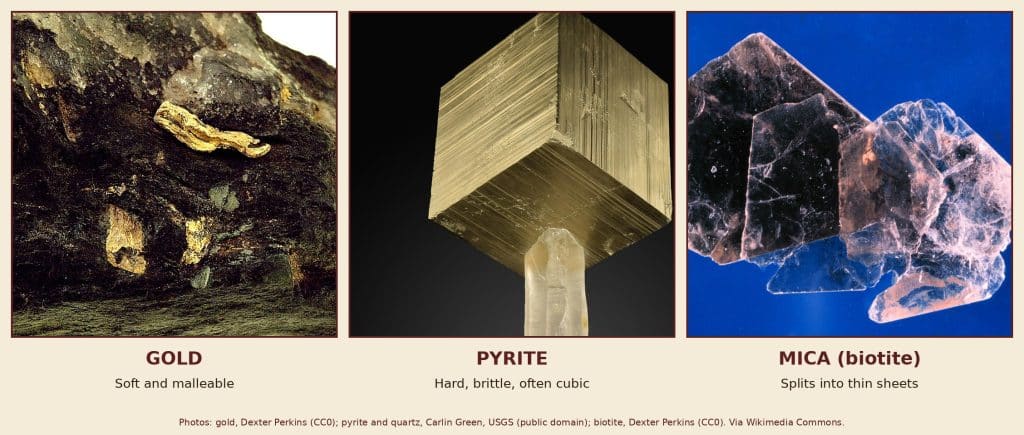
Mica: The Fool’s Gold in Your Pan
Pyrite gets the famous nickname, but in a gold pan, mica is the one that fools a lot of beginners.
Fresh biotite is black, but when it weathers it can turn dark golden or coppery, and people have found those golden flakes in sand and thought they were gold (University of Pittsburgh). Washington DNR lists golden-colored mica flakes among the minerals most commonly mistaken for gold.
Here is how to sort it out at the creek:
- Swirl the pan. Mica floats or washes out easily. Gold lags behind on the bottom (Oregon DOGAMI).
- Bend a flake. Mica springs back. Gold stays where you put it (Washington DNR).
- Press it with a pin. A mica flake breaks, and a tiny flake of gold bends around the pin (Geology.com).
- Hammer a spare piece. Mica breaks into many tiny flakes. Gold can be beaten into thin sheets (Washington DNR).
Do Not Throw Away Every Piece of Pyrite
Pyrite is not gold, but it can be a clue. The USGS points out that iron pyrite often occurs in quartz veins, and that it can have actual gold in its mineral structure (USGS). The University of Minnesota notes that vein pyrite may reveal the presence of other valuable minerals, such as chalcopyrite and gold.
If you are breaking rock and keep finding pyrite in quartz, that ground may deserve a closer look. Seeing pyrite does not tell you how much gold is there, though. For hardrock samples, the USGS describes the fire assay as one of the most commonly used methods for finding gold and silver content (USGS: Gold).
In a placer pan, pyrite is not gold. In a lode sample, it may be a clue worth an assay.
Tools That Make the Job Easier
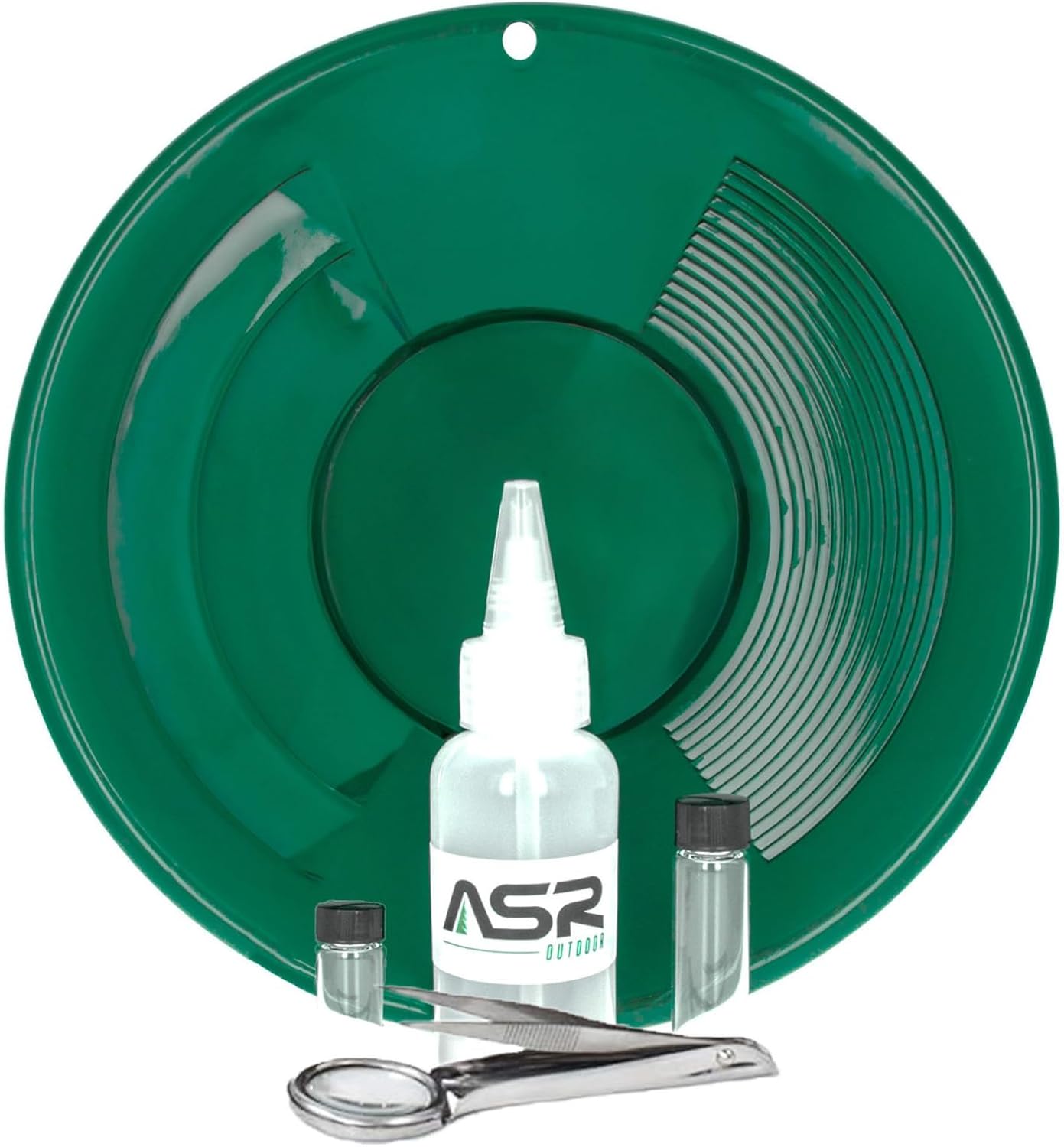
You do not need much. A good pan, magnifying tweezers, a snuffer bottle, and a few vials will handle almost every test in this guide. The ASR Outdoor 5-Piece Beginners Kit in my shop has a dual riffle pan, a snuffer bottle, glass vials, and magnifying tweezers in one package.
For a bigger pan, the SE 14 inch Green Dual Riffle Gold Pan is in the shop too.
If you are new to panning, start with How to Pan for Gold: A Beginner’s Step-by-Step Guide. When you are ready to run more material, see How to Use a Sluice Box. And if your concentrates end up mostly black sand, my process for getting gold out of black sand with no mercury picks up from there.
Gear From Prospectors Cache
I keep prospecting and detecting gear in my Etsy shop, ProspectorsCacheShop, and in my Prospectors Cache eBay store. If you want to see this kind of gear used in the field, check out my Prospectors Cache YouTube channel.
Final Thoughts
Knowing how to tell gold from pyrite and mica will save you a lot of false excitement.
Turn it in the light. Watch where it goes in the pan. Look at the shape. Poke it with a pin. Streak it if the piece is not worth saving.
Gold is soft, heavy, and always gold colored. If it crumbles, splits into sheets, or leaves a black streak, it is not gold.
Learn the look-alikes once, and they will not fool you again.
Sources
- U.S. Geological Survey: What is “Fool’s Gold?”
- U.S. Geological Survey: The Golden Rule on April Fools
- U.S. Geological Survey: Gold (General Interest Publication)
- Washington Department of Natural Resources: Information Circular 57, Handbook for Gold Prospectors in Washington (PDF)
- Oregon Department of Geology and Mineral Industries: Oregon’s Heritage, Recreational Gold Panning (brochure, PDF)
- University of Minnesota, Common Minerals: Pyrite
- University of Pittsburgh: Micas, Muscovite and Biotite
- Geology.com: Fool’s Gold and Real Gold, How to Tell the Difference
Written by Tom Ashworth
Prospectors Cache