

Gold prospecting in Texas is real, but it is not California or Alaska. The gold here is small, it is scattered, and most of the ground belongs to somebody.
I live and prospect in Texas, so I get this question a lot: is there gold in Texas, and where can I legally look for it? This guide to gold prospecting in Texas covers where gold has been reported and the rules you need to know before you put a shovel in the ground.
In Texas, the first question is not where the gold is. It is who owns the ground.
Is There Gold in Texas?
Yes, but not much. The Handbook of Texas says gold mining in the state was never extensive (Handbook of Texas). Most of the recorded gold came out of the Presidio and Hazel mines in West Texas and the Heath mine in the Llano district. Most of it came as a byproduct of silver and copper ores. The same entry says there has been little production since the Presidio mine closed in 1942.
The geologists were blunt about it. In 1911 the U.S. Geological Survey wrote that small quantities of gold may be found at many places in the old rocks of the Llano-Burnet region, but that “in general the quantity is so small as to be valueless from the standpoint of a mining enterprise” (USGS Bulletin 450).
That is fine for a hobby prospector. I am not looking for a mine. I am looking for color in my pan.
Where Gold Shows Up in Texas
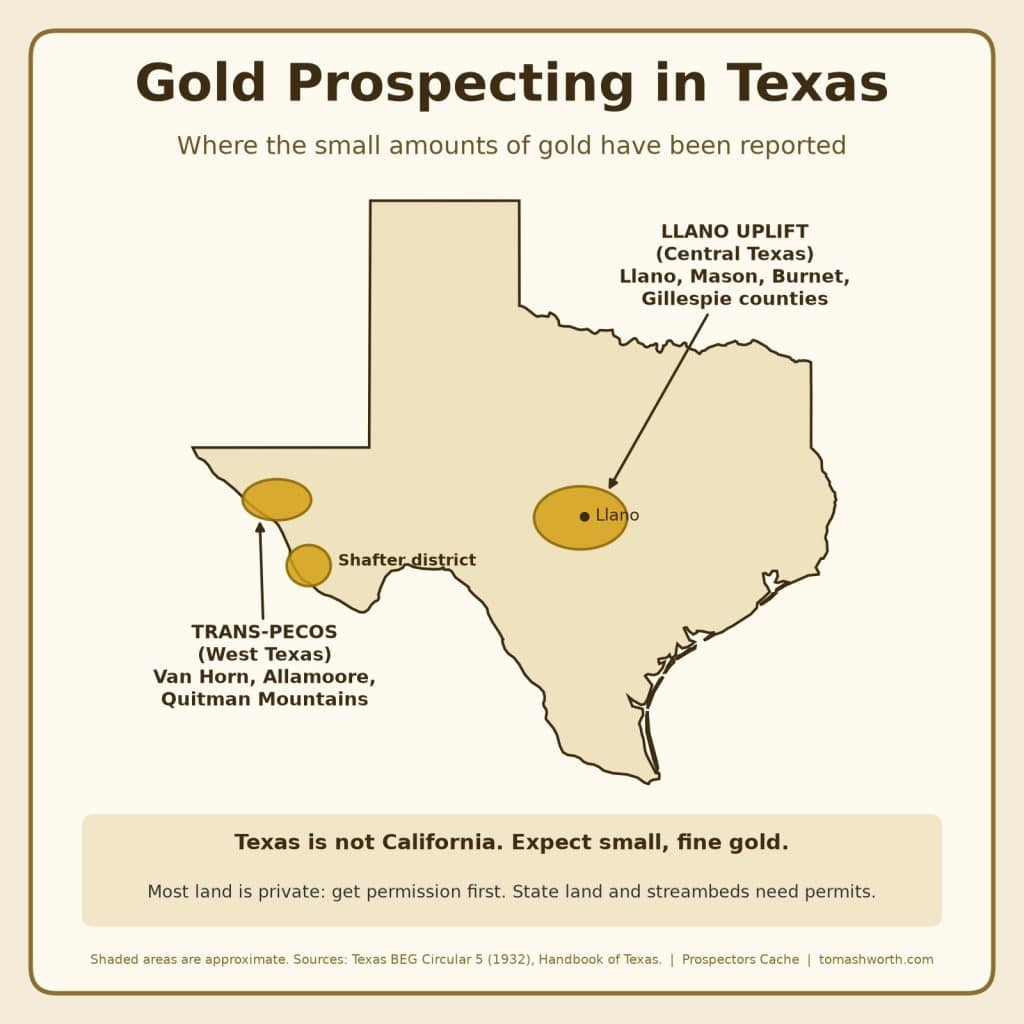
The Llano Uplift
Central Texas is where most hobby gold prospecting in Texas happens. The Bureau of Economic Geology’s 1932 circular “Gold in Texas” says the lode gold of the Llano uplift is confined to small quartz veinlets and stringers in the old metamorphic rocks (BEG Circular 5). It lists Mason and Llano counties, a strip of Gillespie County, and a small area of Burnet County.
The same circular says the search for placer gold is practically restricted to three areas:
- The Colorado River below Kingsland.
- The Llano River basin east of the west line of Mason County.
- Sandy Creek, which has bedrock narrows that are good places for gold to collect.
It also warns that much of this placer gold is likely spread over old valley flats in amounts too small to pay, and that some of it may be very fine “flour gold.” Plan on fine gold, not nuggets.
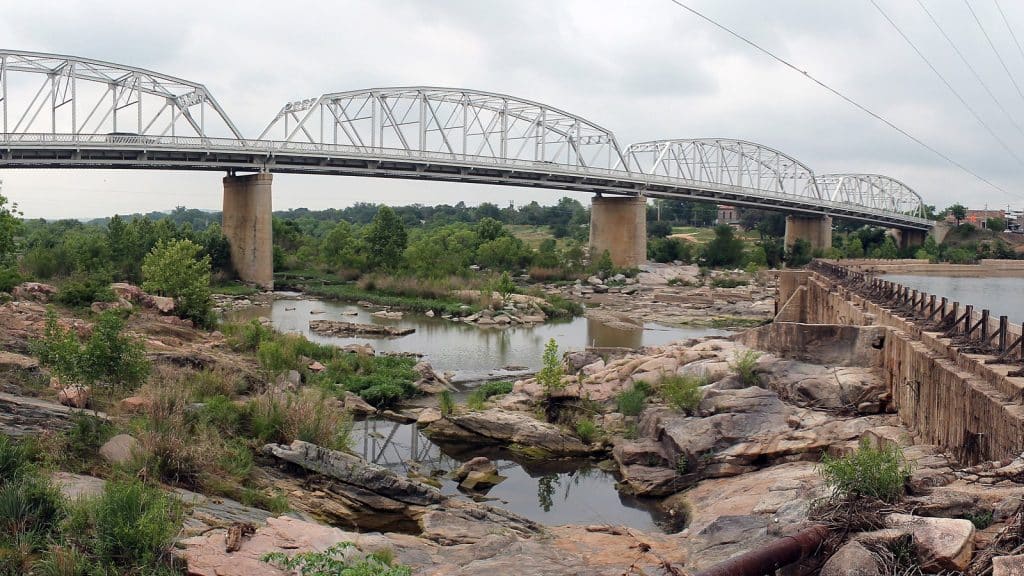
I filmed a day of prospecting on the Llano River for my YouTube channel. You can watch it here:
The Trans-Pecos
West Texas is the other region worth knowing for gold prospecting in Texas. The Handbook of Texas lists traces of gold in the Shafter area and in the Van Horn, Allamoore, and Quitman mountains (Handbook of Texas). Much of that gold came with silver and copper in hard rock, so it is not easy panning country.
Other Reports
The Handbook also mentions traces in Howard, Taylor, Irion, Uvalde, and Williamson counties. The 1932 circular says a small amount of placer gold was found in sandstones of the Gulf Coastal Plain, but not in profitable amounts (BEG Circular 5). If you find something shiny there, check it against my guide on how to tell gold from pyrite.
The Rules for Gold Prospecting in Texas
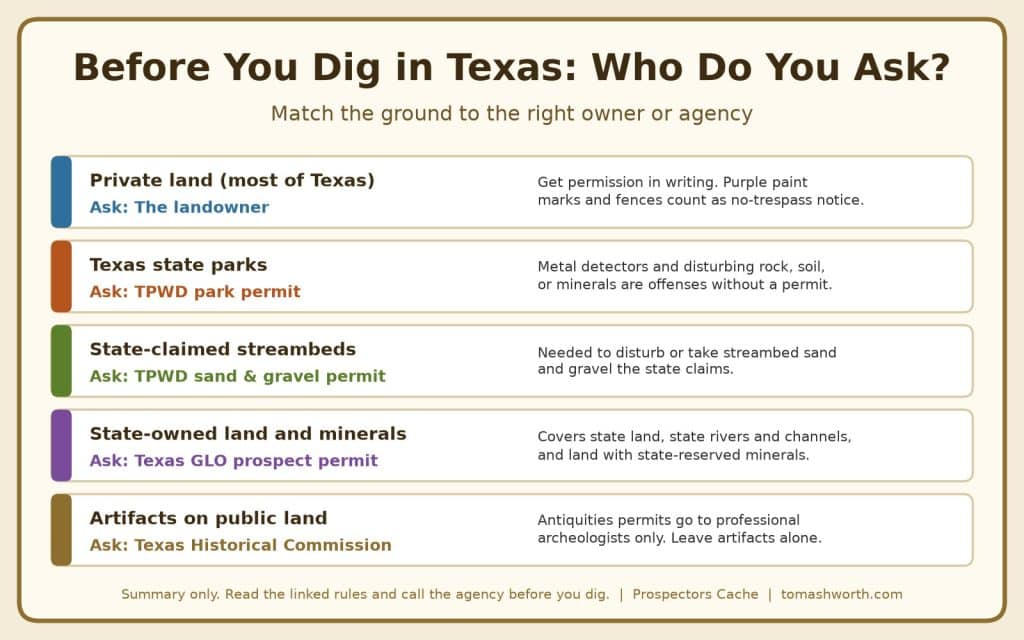
Texas is different from the western states. Texas Parks and Wildlife says more than 95 percent of the land in Texas is privately owned or managed (TPWD). Back in 1932, the Bureau of Economic Geology put it plainly: the mineral rights belong to the landowners, and there is no federal public land a discoverer can acquire (BEG Circular 5). There is no big BLM country to stake claims on like there is out west.
Private Land: Get Permission First
Get permission from the landowner, preferably in writing. Under the Texas criminal trespass law, notice can be a spoken or written warning, a fence, a sign, or purple paint marks on trees or posts (Texas Penal Code §30.05).
The Texas Historical Commission tells metal detecting hobbyists to reach out directly to the owner of the property (THC).
Rivers and Creeks Are Often State Property
This is the rule that surprises most people. Texas Parks and Wildlife says that if a stream is perennial, or more than 30 feet wide between the banks, the State claims the streambed and its sand and gravel (TPWD). A TPWD permit is required to disturb or take those materials.
TPWD also says the law does not differentiate on the size of a project, and that recreational activities still require the applicable permits. Do not assume a shovel and a pan are too small to count. Even owning the land next to the river may not give you the bed. The GLO Surveying Section can tell you whether the State claims a particular streambed.
The penalties are real. A violation is a Class B Parks and Wildlife Code misdemeanor, and the civil penalty runs from $100 to $10,000 for each act or each day (Parks and Wildlife Code Ch. 86). If you want to run a sluice, read my sluice box guide and then check with TPWD first.
Texas State Parks
In state parks, Texas rules say it is an offense to operate or use a metal detector except as authorized by permit (31 TAC §59.134). The same rule makes it an offense to disturb or take any rock, soil, mineral, or other geological deposit without a permit from the director. No permit, no detecting and no digging.
State Land and the General Land Office
The Texas Natural Resources Code says state land is open to prospecting, including rivers and channels that belong to the state and unsold public school land (Natural Resources Code Ch. 53). You apply to the General Land Office for a prospect permit, and it covers no more than 640 acres.
The GLO hard minerals page has the application forms (Texas GLO). Its sample prospect permit says no minerals may be removed in commercial quantities, and any surface-disturbing work needs an approved plan of operation.
Artifacts and Old Treasure
The Texas Antiquities Code makes treasure embedded in the earth on state land, including the beds of its rivers, a state archeological landmark (Natural Resources Code Ch. 191). Those landmarks are the sole property of the State of Texas and cannot be removed without a permit. The THC says it issues antiquities permits only to qualified professional archeologists (THC).
If you find an artifact on public land, leave it where it is.
Federal Land in Texas
National parks, national forests, and other federal land follow federal rules. I covered those in my guide on where you can metal detect.
How I Would Start Gold Prospecting in Texas
- Secure permission first. Find a landowner in the Llano uplift counties and get a yes in writing.
- Ask before you dig a creek. If the stream is perennial or more than 30 feet wide, contact TPWD about the streambed.
- Look at bedrock. Cracks, bars, and narrows on bedrock are where heavy gold settles.
- Classify and pan. Screen your material, then pan it down slowly. Fine gold washes out if you rush.
- Bring a snuffer bottle. Flour gold is too small to pick up with your fingers.
If you are new to the pan, start with my guide on how to pan for gold. For detecting, my article on metal detecting for gold nuggets covers VLF, PI, and ground balancing.
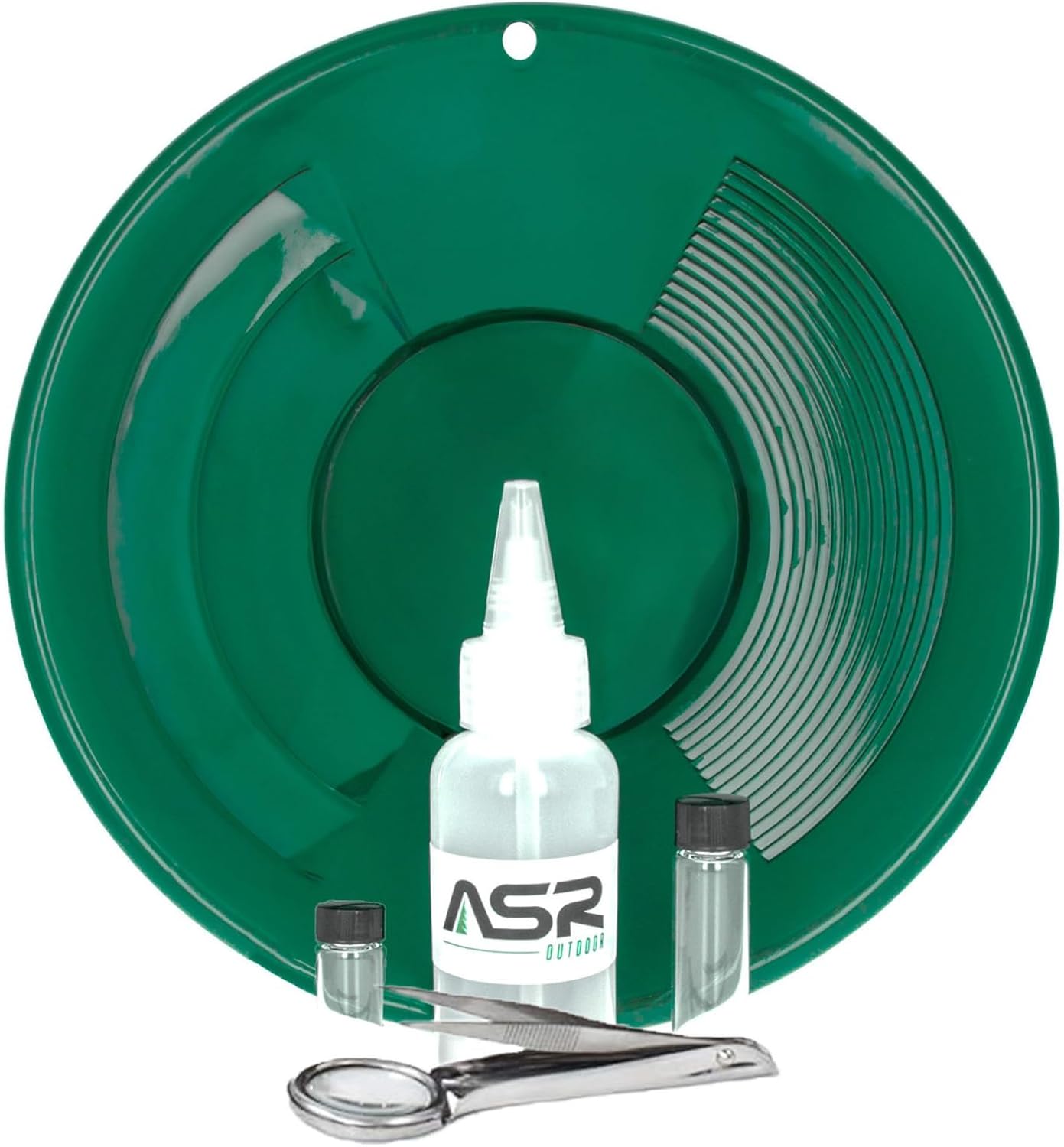
For fine Texas gold, I like a simple setup: the SE 14 inch dual riffle gold pan, the SE 1/8 inch stackable classifier, or the ASR Outdoor 5-piece beginners kit if you want the pan, snuffer bottle, and vials together.
Gear From Prospectors Cache
I also keep prospecting gear in my Etsy shop, ProspectorsCacheShop, and in my Prospectors Cache eBay store. You can see the gear in use on my Prospectors Cache YouTube channel.
Final Thoughts
Gold prospecting in Texas is a small-gold hobby. The Llano uplift is the best place to start, and the Trans-Pecos is the other region with recorded gold.
The rules matter more here than the geology. Get landowner permission, treat purple paint as a no, and check with TPWD before you dig in a riverbed.
Sources
- Handbook of Texas Online (TSHA): Gold Mining
- USGS Bulletin 450: Mineral Resources of the Llano-Burnet Region, Texas (Paige, 1911, PDF)
- Bureau of Economic Geology, Mineral Resource Circular 5: Gold in Texas (Baker, 1932)
- Bureau of Economic Geology, Mineral Resource Circular 56: Gold and Silver in Texas (Evans, 1975), further reading
- Texas Parks and Wildlife: Lone Star Land Steward Awards (private land in Texas)
- Texas Parks and Wildlife: Sand, Gravel, Shell and Marl FAQ
- Texas Parks and Wildlife Code, Chapter 86
- 31 Texas Administrative Code §59.134 (state park rules)
- Texas Natural Resources Code, Chapter 53 (prospecting on state land)
- Texas General Land Office: Hard Minerals
- Texas Natural Resources Code, Chapter 191 (Antiquities Code)
- Texas Historical Commission: Archeology FAQ
- Texas Penal Code, Chapter 30 (§30.05 criminal trespass)
Written by Tom Ashworth
Prospectors Cache
Great guide, Tom — the point about permission coming before geology really stood out to me. I follow gold prices and prospecting closely, and it is striking how different Texas is from the western states: fine flour gold in the Llano Uplift rather than nuggets, and over 95 percent private land, so written landowner permission really is step one. Your note about bedrock cracks and narrows on the Llano River, and taking it slow when panning down fine gold so it does not wash out, is exactly the kind of practical detail beginners need. Thanks for pulling the sources together so clearly.