

Metal detecting for gold is not the same game as hunting coins in a city park. The targets are small, they are spread out, and the ground itself fights you the whole time.
A lot of beginners spend their energy on one question: which detector should I buy? The better questions are what kind of ground you will hunt and whether you know how to ground balance on it.
This guide covers the two main detector technologies, VLF and PI, and the ground balancing basics that make either one work.
A gold detector is only as good as its ground balance.
Why Metal Detecting for Gold Is Harder
Gold ground is often mineralized. Minelab explains that minerals in the soil interact with the detector’s electromagnetic field, which causes ground noise, distorted target signals, and less depth (Minelab).
There are two main kinds:
- Iron-rich mineralization, found in red clay, black sand, and soils high in iron oxides.
- Salt-based mineralization, found in wet beach sand, tidal flats, and alkali soils.
Garrett says the same thing: mineralized soil can mimic metal targets, hide real ones, and cut detection depth (Garrett). Garrett’s AT Max manual groups hot rocks with magnetite, black sands, and other highly ferrous ground (Garrett). If you have panned black sand, you have already met the minerals behind a lot of this noise.
VLF vs. PI Detectors for Metal Detecting for Gold
VLF Detectors
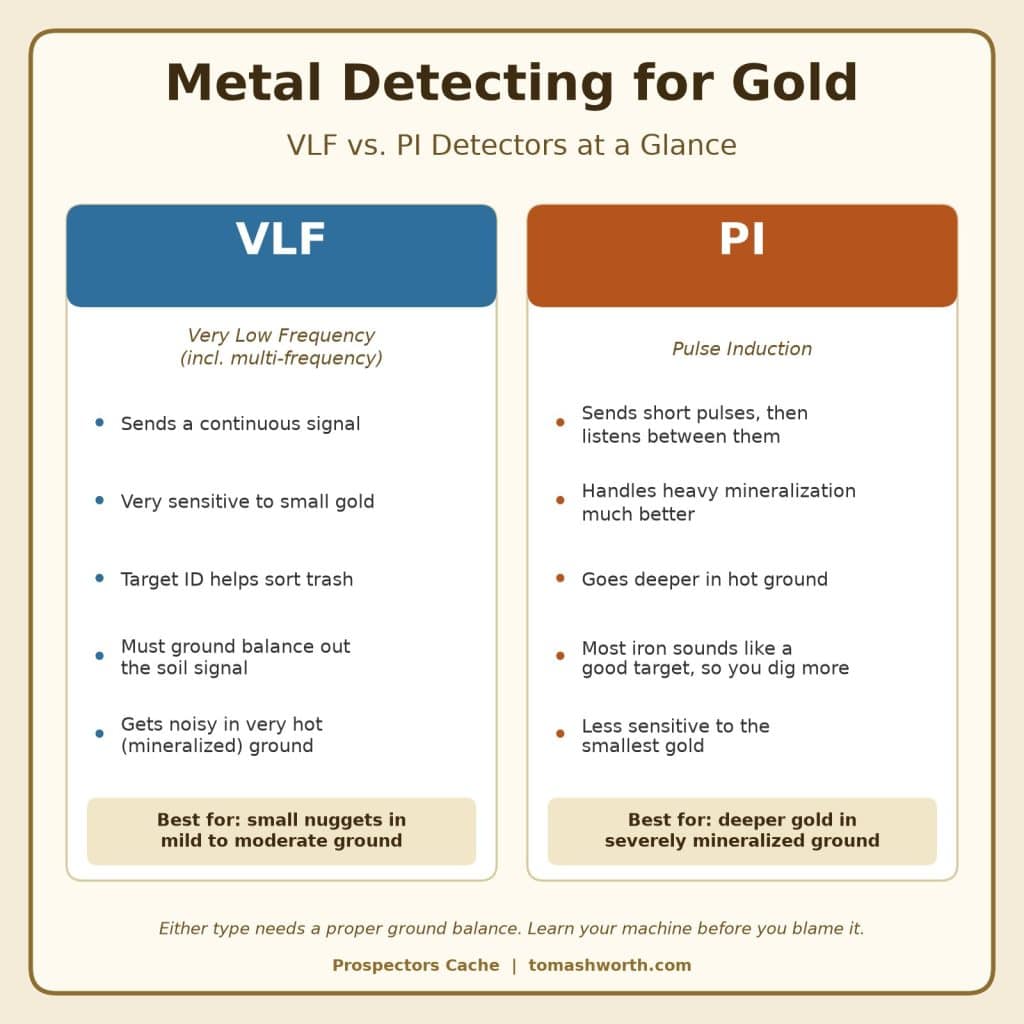
VLF stands for Very Low Frequency. A VLF detector transmits a continuous sine wave and has to ground balance out the soil signal while it hunts (Minelab). Minelab counts almost every technology other than PI as continuous wave, and that includes multi-frequency machines.
The big strength of a VLF is small gold. Minelab notes that pulse induction has less ability to detect very small nuggets than VLF detectors. Higher frequencies help too. XP’s Deus II manual says a high frequency such as 45 kHz will detect a far greater proportion of small targets than a low frequency like 4 kHz, above all in mineralized ground. The Manticore manual says its Goldfield mode is optimized for low-conductive gold nuggets, which are more easily detected at higher frequencies (Minelab Manticore manual).
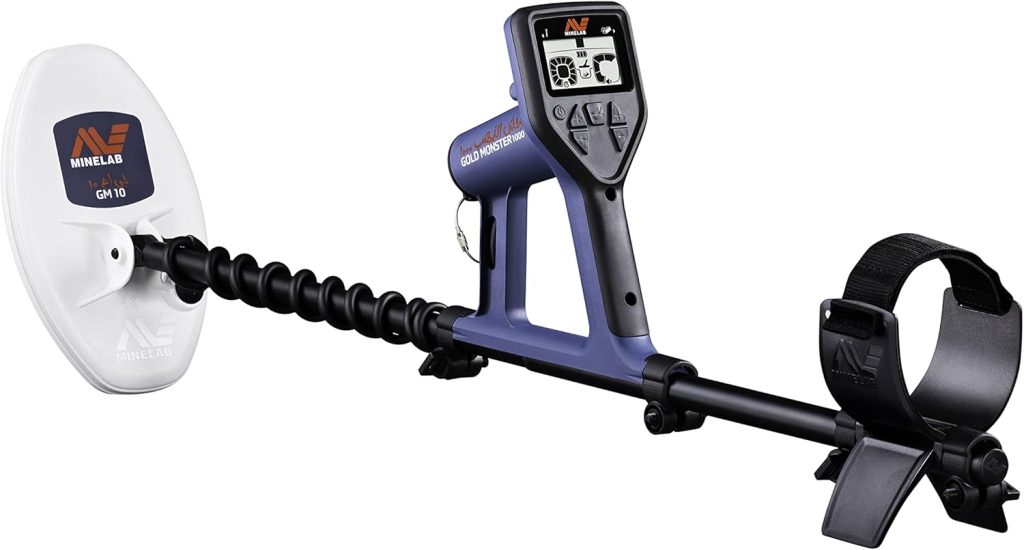
Single-frequency gold machines such as the Minelab Gold Monster 1000 (45 kHz) and the XP ORX are built around that idea. VLF machines also give you target ID, which helps you sort trash.
The weak spot is very hot ground. A VLF has to cancel all of the soil signal at once, and in heavy mineralization it gets noisy.
PI Detectors
PI stands for Pulse Induction. A PI detector sends short pulses to the coil and then reads the decaying signal from metal targets after each pulse ends (Minelab). Minelab says this gives PI a major ground balancing advantage, because it does not even detect the biggest part of the soil signal.
Garrett’s takeaway is simple: pulse induction detectors outperform VLF models in highly mineralized soil (Garrett).
There is a trade-off. Garrett’s ATX manual says that to a PI detector most iron behaves like a good conductor (Garrett ATX manual). It also warns that turning up discrimination starts dropping small nuggets. So with a PI, you dig more trash.
VLF: better on small gold in mild ground. PI: better depth in hot ground. Neither one is magic.
Which One Should a Beginner Pick?
Start with the ground you will actually hunt.
- Mild to moderate ground, small gold, exposed bedrock, or trashy old camps: a gold-capable VLF or multi-frequency machine.
- Severely mineralized ground or deeper gold: a PI is the stronger tool.
- Just starting out: learn one machine well before you buy a second one.
My own setup for metal detecting for gold is VLF-family, not PI. My main gold coil is the HF2 on my XP Deus 2. XP says the HF2 coil is well suited to small targets because of its higher working frequencies (XP Deus II manual). I also run my Minelab Manticore with the M8 coil, an 8 x 5.5 inch elliptical Double-D.
Small Double-D coils make sense in gold ground. Minelab says DD coils perform better in mineralized ground, and smaller coils help isolate targets there (Minelab).
If you are still shopping, my Best Metal Detectors for Christmas 2026 picks cover detectors by budget.
Ground Balancing Basics for Metal Detecting for Gold
Ground balance is the detector’s ability to compensate for ground mineralization. Minelab says the better a detector can ground balance, the deeper it will detect in mineralized ground (Minelab).
Most gold machines give you three options:
- Manual: you set the value yourself.
- Automatic (auto or grab): you pump the coil and the detector sets the value.
- Tracking: the detector keeps adjusting as the ground changes.
Step 1: Find Clean Ground
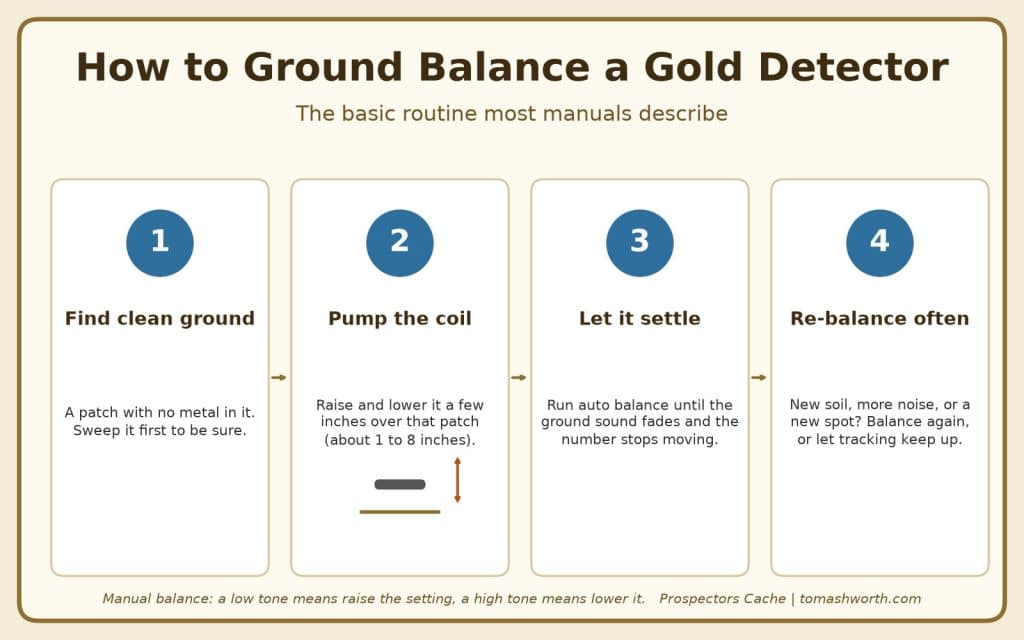
Minelab and Garrett both say to ground balance over a patch of soil with no metal targets in it (Minelab, Garrett). Sweep the spot first to make sure it is clean.
Step 2: Pump the Coil
Raise and lower the coil over that clean patch. Garrett’s AT Max manual says to bounce the coil from 1 to 8 inches above the ground (Garrett). XP’s Deus II manual describes about 15 cm, or 6 inches, of vertical movement (XP).
Step 3: Let It Settle
On the Manticore, you hold the Auto Ground Balance key and keep pumping until the value settles and the audio stabilizes. If that does not cut the noise in very hot ground, the manual says to repeat it with a side-to-side sweep (Minelab).
On a manual balance, a low tone means raise the setting and a high tone means lower it. Both Minelab and Garrett say this in their manuals.
Step 4: Re-Balance Often
Ground changes as you walk. Minelab makes Tracking Ground Balance the default for the Manticore’s Goldfield mode because most goldfields have variable iron mineralization. A manual adjustment turns Tracking off.
XP takes a different approach. Its Gold Field program is all metal and rejects only the ground you grabbed, so XP says to grab again regularly. XP also says tracking works best where mineralization is fairly uniform and changes slowly.
Dealing With Hot Rocks and Trash
Hot rocks are mineralized stones that can make a detector react as if it found a target. XP’s advice is to set them aside for future reference. That way you learn what the local hot rocks look and sound like.
Do not chase every noise with your settings. XP’s Gold Field notes say to lower the sensitivity on highly mineralized ground, setting it just below the point where the detector gets unstable, and to raise reactivity in strong mineralization for more stability (XP).
Dig your iron, at least at first. With a PI you will dig a lot of it. With a VLF, keep discrimination low. XP warns that gold nuggets are often seen as the ground or as ferrous items in this kind of tricky ground.
Know the Rules Before You Swing
Before metal detecting for gold on BLM land, check for mining claims. The BLM says rockhounds may prospect with hand tools, including metal detectors, if it causes no more than minor surface disturbance. It also says collecting on an existing mining claim is prohibited without the claim holder’s permission (BLM).
National parks, national forests, and state land each have their own rules. I covered those in my guide on where you can metal detect. When the detector goes quiet, a pan still works. See my guide on how to pan for gold.
Gear From Prospectors Cache
I keep prospecting and detecting gear in my Etsy shop, ProspectorsCacheShop, and in my Prospectors Cache eBay store. You can see it in use on my Prospectors Cache YouTube channel.
Final Thoughts
Metal detecting for gold comes down to two things: the right type of machine for your ground, and a good ground balance.
Pick VLF for small gold in milder ground. Pick PI for depth in hot ground. Balance over clean dirt. Re-balance when the ground changes. Dig your signals and learn your hot rocks.
Sources
- Minelab: Detecting in Mineralized Soils: Understanding and Overcoming Ground Signals
- Minelab Knowledge Base Article 04-1: Metal Detecting Terminology (PDF)
- Minelab Knowledge Base Article 24-1: Basics of the GPZ 7000 Technology (PDF)
- Minelab MANTICORE Instruction Manual (PDF, hosted by a Minelab dealer)
- Garrett: Ground Mineralization and Metal Detectors
- Garrett ATX Owner’s Manual (PDF)
- Garrett AT Max International Owner’s Manual (PDF)
- XP DEUS II User Manual, WS6 version (PDF)
- XP DEUS II User Manual, remote control version (PDF)
- Bureau of Land Management: Can I Keep This?
Written by Tom Ashworth
Prospectors Cache