

New detectorists ask me the same question all the time: where can you metal detect without getting into trouble? The honest answer is that it depends on who manages the ground under your feet.
A swim beach at a lake, a gold patch on BLM land, and a trail in a national park can sit a few miles apart and have completely different rules. Some places welcome detectors. Some ban them outright. Some say yes, but only in certain spots.
This guide walks through the main types of public land in the United States, plus Texas state parks and private land, and what the regulations actually say.
Before you swing a coil, find out who manages the land.
Where Can You Metal Detect? Start With Who Manages the Land
Federal land is split between different agencies, and each one has its own rulebook. A national forest, a national park, and BLM land can all look like open country, but the rules are not the same.
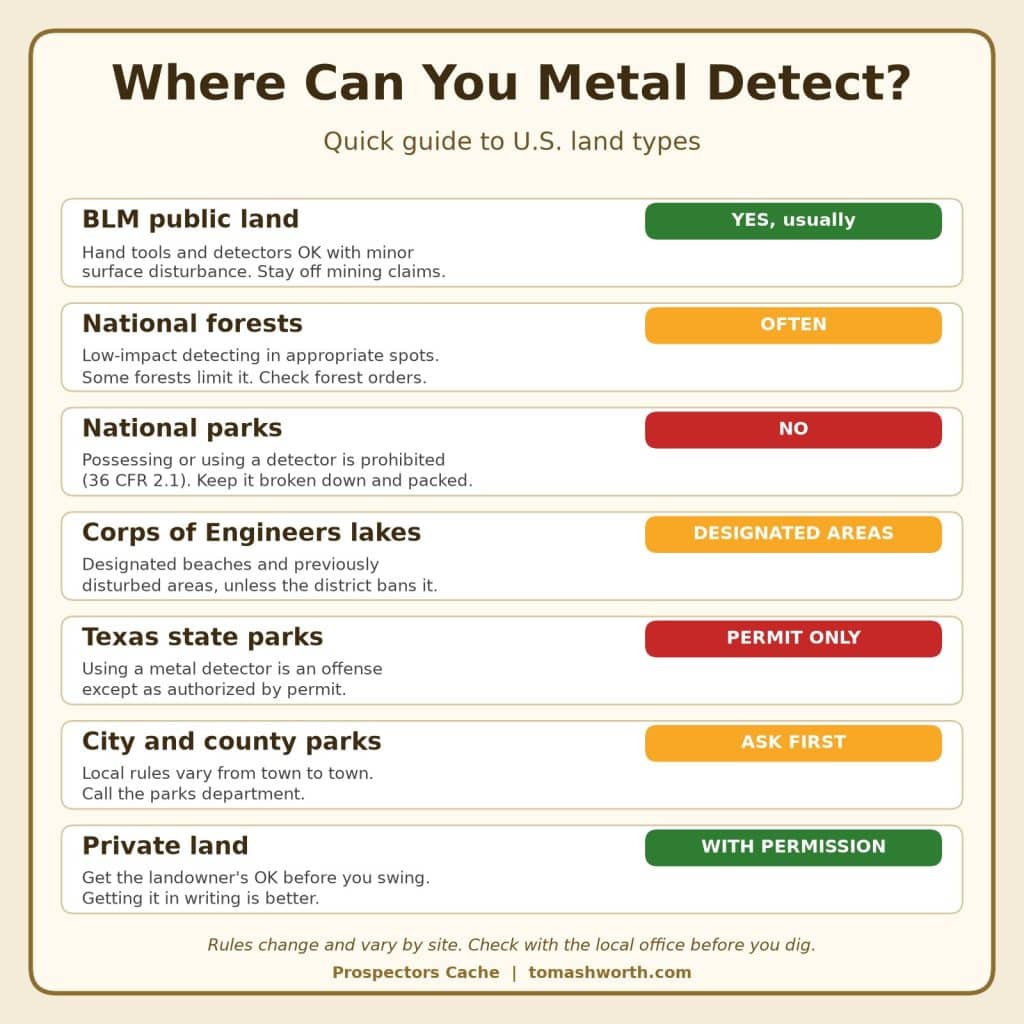
Most of the time, the answer to “where can you metal detect?” comes down to the agency in charge. Here is the short version.
BLM Public Land: Usually Open
BLM ground is the friendliest public land for detecting, especially for gold. The BLM says rockhounds may collect reasonable amounts of rocks and mineral specimens, including gold, silver, and other precious metals, and may prospect with hand tools such as pans, shovels, and metal detectors if it causes no more than minor surface disturbance (BLM).
The regulation behind that is 43 CFR 8365.1-5. It allows collecting reasonable amounts of rocks and mineral specimens for noncommercial purposes, and it names metal detectors as an exception to its ban on motorized or mechanical collecting devices (eCFR).
The BLM lists a few places where that does not apply:
- Developed recreation sites, such as picnic areas and campgrounds, unless collecting is otherwise permitted.
- Existing mining claims, unless you have the claim holder’s permission.
- Wilderness and Wilderness Study Areas, where only non-motorized hand tools may be used and surface disturbance must be minimal.
The BLM also asks you to contact them before going past casual use, such as using mechanized equipment or selling what you find (BLM, Can I Keep This?).
Claims are the big one for gold hunters. Minerals on a mining claim belong to the claim holder, and the BLM points people to its Mineral and Land Records System (MLRS) to look up claim records. A good gold machine like the Minelab Manticore will find nuggets, but it will not tell you whose claim you are standing on.
National Forests: Often Allowed, With Limits
The U.S. Forest Service says metal detecting is allowed as a low-impact recreational activity in appropriate locations. You may search for small, modern items such as coins or jewelry and dig shallow holes that you can fully backfill (USFS).
According to the Forest Service, detecting is typically allowed in developed recreation sites such as campgrounds, picnic areas, and swimming beaches, unless specific regulations or signs prohibit it. It also warns that many campgrounds sit on long-used Native American cultural sites.
Each national forest can set tighter limits.
For example, the George Washington and Jefferson National Forests allow metal detectors at the swimming beach at Sherando Lake Recreation Area and prohibit detecting everywhere else on that forest (USFS). Check the forest’s alerts and orders, or call the ranger district, before you go.
Gold prospecting with a detector falls under the mining rules. The Forest Service says mineralized land may already be claimed, and that prospecting that causes surface disturbance requires filing a Notice of Intent under 36 CFR 228A. Searching for treasure trove, meaning deliberately hidden coins, gems, or bullion, requires a special use permit (USFS).
National Parks: Leave the Detector Packed
National Park Service rules prohibit possessing or using a metal detector in park areas (36 CFR 2.1(a)(7)).
The exceptions are narrow: a detector broken down and stored or packed so it cannot be used, navigation electronics for boats and aircraft, and detectors used for authorized scientific, mining, or administrative work.
That includes Park Service units here in Texas, such as Padre Island National Seashore. Not every national monument is run by the Park Service, though, so check who manages it.
If the sign says National Park Service, the detector stays packed.
Corps of Engineers Lakes: Designated Areas Only
Many lakes are U.S. Army Corps of Engineers projects. Corps rules permit metal detectors on designated beaches or other previously disturbed areas, unless the District Commander prohibits it to protect archaeological, historical, or paleontological resources (36 CFR 327.14).
The rule says the Manager’s Office has the local policy and designated areas. Found items go through the Corps lost-and-found rules, except non-identifiable items such as coins worth less than $25.
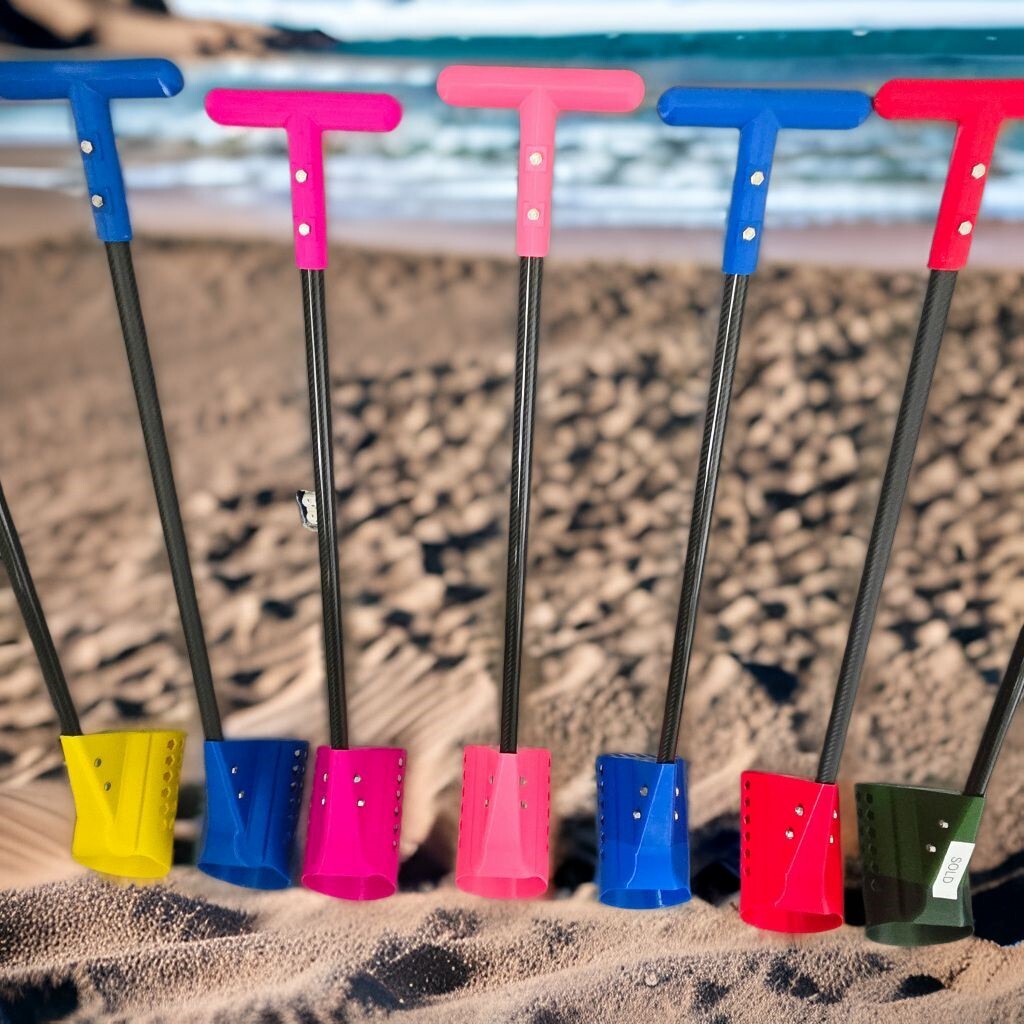
On a designated swim beach, a long-handled scoop saves your back. I build the carbon fiber Metal Detecting Beach Sand Scoop for that kind of hunting.
State Lands: Texas State Parks Need a Permit
State rules vary a lot, so check with the state agency wherever you hunt. Here in Texas, the state park rule is blunt: “It is an offense for any person to operate or use a metal detector, except as authorized by permit” (31 TAC 59.134(i)).
Unless you have that permit in hand, leave the detector in the truck at a Texas state park.
The Texas Historical Commission adds that state law prohibits collecting artifacts from public property without an antiquities permit, which it issues only to qualified professional archeologists. Its advice to hobbyists is to contact the owner of the property, public or private, for permission (THC).
City and county parks set their own rules, from open to permit-only to banned. Call the parks department before you go.
Private Land: Get Permission First
Private land holds a lot of good hunting, but only with the owner’s permission. That is the same advice the Texas Historical Commission gives hobbyists.
Ask for permission in writing if you can. Agree up front on who keeps what. Fill every hole.
Helping someone find a lost ring is a good way to meet landowners. I wrote about that work in Lost Item Recovery.
Old Coins, Relics, and ARPA
On federal land, the Archaeological Resources Protection Act (ARPA) is the law every detectorist needs to know. Its regulations define an archaeological resource as material remains of human life or activities that are at least 100 years old and of archaeological interest (43 CFR 7.3).
Those regulations say coins and bullets are not archaeological resources unless they are found in a direct physical relationship with archaeological resources. The BLM is stricter in practice. Its collecting page lists historic coins among the cultural items you cannot collect, and says only modern money may be collected.
Forest Service rules prohibit digging in, disturbing, or removing any prehistoric, historic, or archaeological resource (36 CFR 261.9). If you find something, the Forest Service says to stop detecting and report it to the local office.
Modern coins and jewelry are fair game where detecting is allowed. Relics and old coins on federal land stay where they are, and you report them.
Where Can You Metal Detect Near You? A Quick Checklist
- Find out who manages the land: BLM, Forest Service, Park Service, the Corps, the state, the city, or a private owner.
- Check that agency’s current rules, orders, and posted signs.
- On gold ground, look up mining claims in MLRS before you dig.
- On private land, get the owner’s permission first.
- Fill every hole and pack out the trash you dig up.
- Leave old artifacts in place and report them.
If you are still picking a machine, see my Best Metal Detectors for Christmas 2026 picks. For gold country, my guides on how to pan for gold and how to use a sluice box cover the BLM and Forest Service rules for those methods too.
Gear From Prospectors Cache
I keep prospecting and detecting gear in my Etsy shop, ProspectorsCacheShop, and in my Prospectors Cache eBay store. You can see it in use on my Prospectors Cache YouTube channel.
Final Thoughts
So, where can you metal detect? On a lot more ground than most beginners think, as long as you check the rules first.
Know who manages the ground. Check the rules. Fill your holes. Leave the history where it lies.
Sources
- Bureau of Land Management: Can I Keep This?
- Bureau of Land Management: Can I Keep This? Guide to Collecting on Public Lands (PDF)
- 43 CFR 8365.1-5, Property and resources (BLM)
- U.S. Forest Service: Metal Detecting
- U.S. Forest Service, George Washington and Jefferson National Forests: Metal Detecting Policy
- 36 CFR 261.9, Property (Forest Service)
- 36 CFR 2.1, Preservation of natural, cultural and archeological resources (National Park Service)
- 36 CFR 327.14, Public property (U.S. Army Corps of Engineers)
- 31 Texas Administrative Code 59.134, Rules of Conduct in Parks
- Texas Historical Commission: Archeology FAQ
- 43 CFR 7.3, Definitions (Protection of Archaeological Resources)
Written by Tom Ashworth
Prospectors Cache